
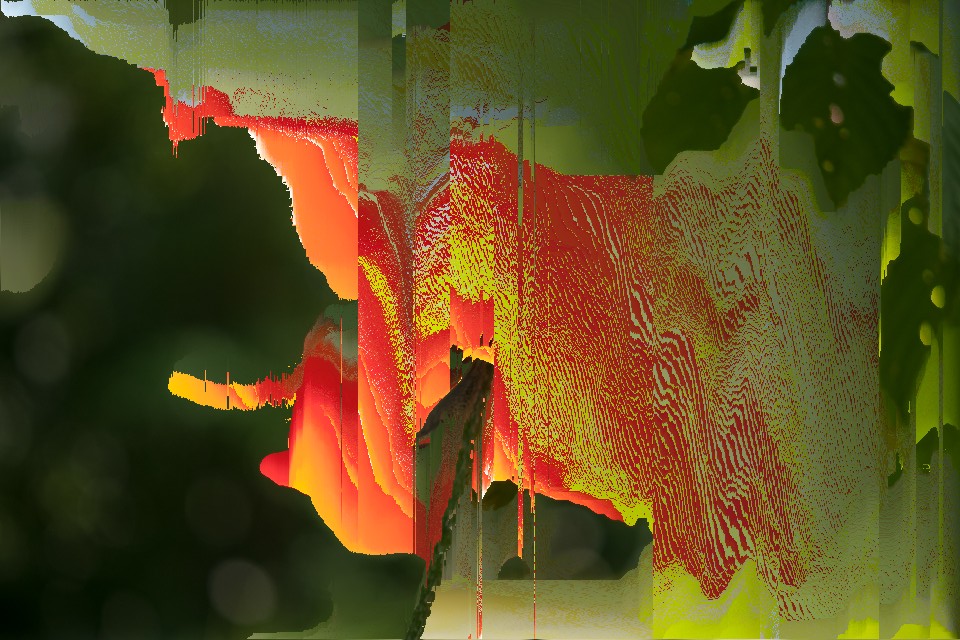
I learned about glitch art about half a year ago. It sounded interesting and idea stayed in the background. About a month ago I started coding. I made a program that reorders values of red, green and blue in each pixel of an image. Results were encouraging and I made another version and another. Tried a bit different way to mix pixels and another. In a month I’ve done ten algorithms to modify images and some automation and control to keep things in line. I have about 700 distorted images. Of course most of them are no good and will never be published. Combining those ten algorithms I can create untold numbers of new images. Again most of them are no good, but some are.
Glitch art
Glitch is a problem in any system. Sometimes glitches cause distortions in images, sound or video. Those are the most common media used in glitch art. Glitch art does not just rely problems occurring sometimes – they can be caused intentionally by misusing software or hardware. My first contact was pixel sorting. In pixel sorting part of pixels in image are sorted. Sorting means ordering from smallest to largest. Usually pixels are sorted by their brightness, but in fact any numerical property or value can be used.
Breaking images
It all started so innocent, but I wanted stronger effects, brighter colours and more distortion. It all turned to a quest to break the image. Not completely though, I still want it to be recognizable to some extent. At the same time I have learned a thing or two about what makes an image tick. Sure I’ve improved contrast in post-processing of a photograph and I have boosted colours too.

Images are surprisingly robust; you can mess with colours quite a bit before they completely break. You can move pixels around and still have recognizable images. But methods I used cannot be achieved in photoshop. It doesn’t allow you to break the curve nor sort pixels. That’s why I have made my own programs or algorithms.
Why glitch art? Why break image?
Of course there’s not just one reason, but it sure is fun. I’m a programmer and it’s awfully liberating to code without need to create neat, readable and above all error free code. What else a programming error is, but another glitch to exploit for glitch art? End result, the glitched image, tells whether code is good or not. Glitching is also a stand against urge to make everything nice, neat or perfect. World is imperfect and it’s futile to try to create perfect and neat bubbles to live in. Last reason is the most compelling one and comes from belief that things can break so completely that after break it’s possible to make something completely new, something that you could not even imagine was possible.
A physicist and chemist Ilya Prigogine studied irreversible thermodynamics – events that cannot be reversed. Events that can only by understood afterwards. From what happens before can not be seen what happens next. They are non deterministic. Bruce Sterling uses similar breaks as a plot device in his novels besides references to Prigogine in Schismatrix. I see glitch art and breaking images in bit similar light. Breaking images opens up a possibility to create something new, something that is not a direct continuation to current practice of art.

Pingback: Project politics - Artist and Photographer Harri Kemppainen